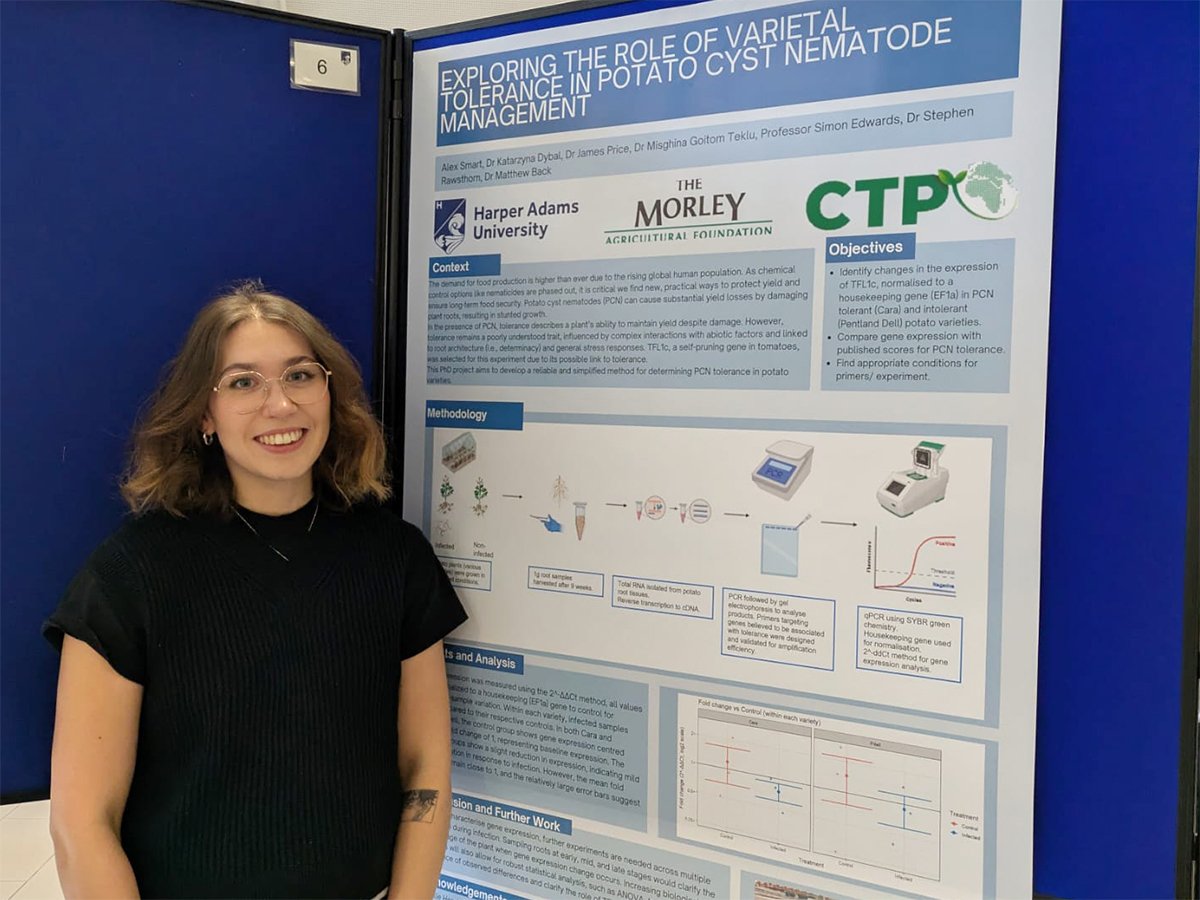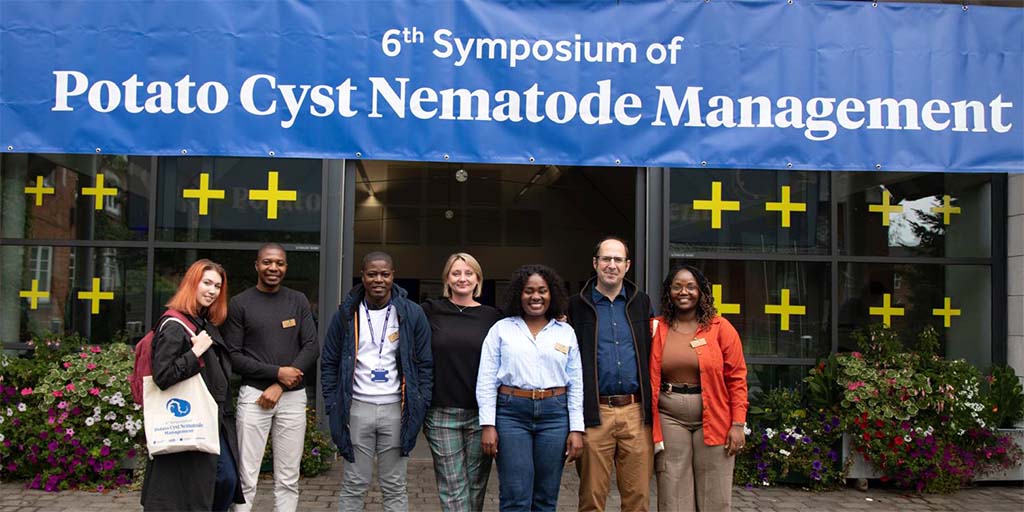

The third example of current TMAF support for younger scientists features Alex Smart. In her first year of her PhD, she describes the balancing act between coursework, literature reviews, academic papers, learning new lab techniques, and starting pilot experiments.

Alex Smart
Pursuing a PhD is both an academic challenge and a personal journey. As a first-year doctoral student at Harper Adams University specialising in nematology and plant pathology, my research focuses on a critical and persistent issue in crop production: the potato cyst nematode (PCN), a soil-borne pest that causes significant yield losses (up to 80%). The UK’s last remaining nematicide, fosthiazate, is likely to lose approval by 2027 (PubChem, 2025), meaning that control of PCN will soon become more challenging.
Investigating varietal tolerance in potatoes to combat PCN
My work specifically investigates varietal tolerancein potatoes to PCN. In this instance, varietal tolerance is the amount of damage a given potato variety can withstand from PCN, whilst still being able to maintain an acceptable yield. Tolerance has been linked to root architecture (i.e., determinacy), and general stress responses. Despite its agronomic value, it is often overlooked in breeding programmes, with a tendency to focus on resistance traits. Testing for tolerance is extremely laborious and requires access to multiple fields across multiple seasons.
My PhD aims to find a simplified method for assessing tolerance in potato cultivars through several interconnected approaches. With this aim in mind, this is a typical day.
Beginning the Day
The day starts with planning, preparation and coffee. I typically reply to my emails at this time, review my schedule for the week (glasshouse tasks, and lab responsibilities) over a cup of coffee. Organisation is key, particularly in the first year of a PhD when building a solid foundation is essential. I typically get to campus for 7-7.30am.
Greenhouse Work: Monitoring and Sampling
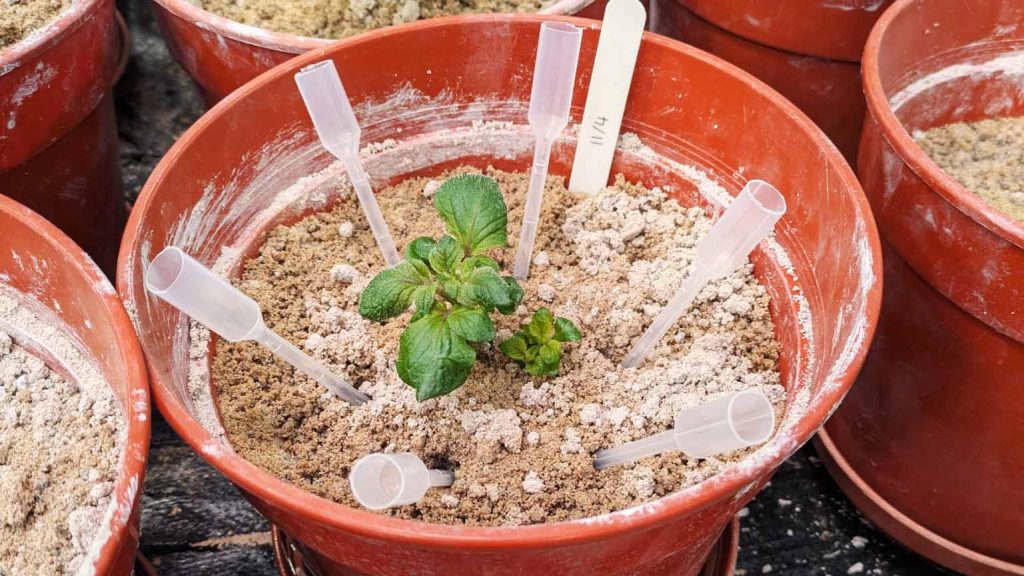
Much of my experimental work takes place in controlled glasshouse environments, or the molecular laboratory. In the glasshouse, I was (until recently) rearing up a population of PCN on a susceptible cultivar (Desiree). I spent the mornings monitoring the potato plants for any sign of disease, or presence of unwanted pests (such as aphids).
The glasshouse population of cysts will be used in the future as part of my ‘timepoint experiment’. I will share more details in my next update.

Cyst Rolling and Counting
I am working through the soil samples using a ‘Fenwick Can’ to extract 500g of soil. As water is passed through the Fenwick Can, heavy soil particles settle at the bottom of the can, while lighter cysts and debris float up and are carried over the overflow collar into a collecting sieve – separating the cysts from the soil. I place the cysts in a silk bag, where once dried, will be rolled and counted in the nematology lab. I will later test the viability of these cysts.
Lunch and Literature
After the morning’s practical work, I take a break for lunch, often spent with fellow PhD students. These informal discussions are a valuable part of academic life, offering new perspectives and shared experiences.
Supervisory Meetings
Later in the day, I usually meet with my supervisor to discuss recent findings, troubleshoot issues, and refine upcoming experiments. First-year PhD work involves a significant amount of trial and error, and having structured guidance is essential for staying on track. These meetings are invaluable and help ensure my research remains aligned with broader project goals. I’m fortunate to have a diverse supervisory team, with expertise across different disciplines, which leads to rich, engaging discussions. I always leave these meetings feeling inspired and motivated.
Refining my Molecular Techniques
I have recently been trying to perfect the conditions for PCR and qPCR (the techniques I use to measure DNA), this preparation is crucial for the success of my upcoming timepoint experiment, where precision and reproducibility will be key.
This work involves fine-tuning various factors such as, annealing and denaturing temperatures, reagent concentrations, and cycle conditions to ensure specific and efficient amplification. I also run multiple test reactions and analyse melt curves, as well as amplification plots produced by the qPCR machine to confirm that the reactions are working as intended.
By investing time now to get these conditions right, I’m aiming to minimise errors and avoid unnecessary repetition later. It’s a methodical process, but one that will be incredibly rewarding when everything finally works!
Literature Review and Reading
I usually dedicate the afternoon to reviewing recent scientific literature or working on reports, which fits well in between PCR/qPCR runs. Currently, my focus is on exploring the subtle but important distinction between resistance and tolerance – two concepts that are frequently conflated in earlier research.
Wrapping up
I conclude the day by briefly looking at the qPCR data, checking emails, tidying the lab, and preparing materials for the following day’s work.
While the first year of a PhD can be overwhelming at times, it is also deeply rewarding. Each day brings new skills, questions, and insights. Although I’m still early in my research, I can already see how my work fits into the bigger picture. Even when I’m deep in the technical details, I know I’m contributing to something meaningful.